

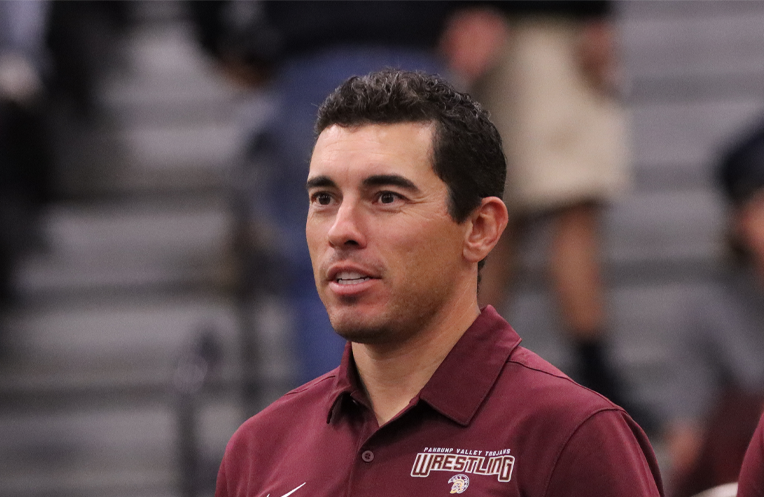

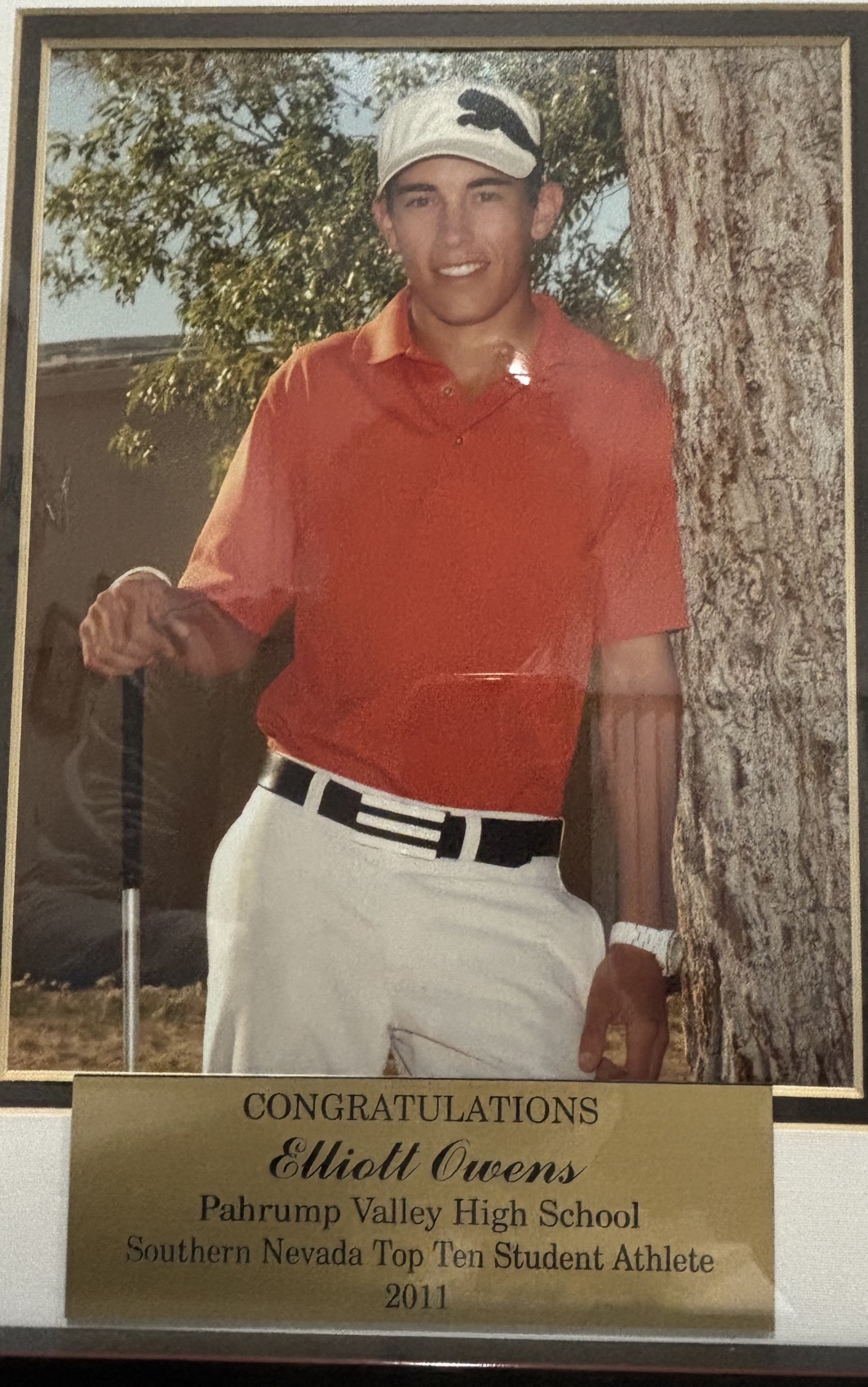
Elliott Owens graduated from Pahrump Valley High School in 2011, but the way he talks about his years as a Trojan makes it clear that high school was not simply a phase he passed through—it was a foundation. It was where he learned how to commit to a team, how to lead in ways that aren’t always flashy, and how to find balance between pressure and joy. Those lessons still show up today in the way he works, the way he coaches, and the way he welcomes people onto a golf course with the goal of making their entire day better.
In high school, Elliott’s life revolved around activity—especially sports. He describes it simply and honestly: “Sports, sports, sports, sports.” He earned 11 varsity letters, missing only the fall season of his freshman year because he was on junior varsity soccer at the time. Even now, he laughs that he was chasing a personal benchmark—his cousin Sara Coleman had earned 12 varsity letters, and he wanted to match it. The fact that he still remembers that detail says something about how competitive he was, but it also says something about how invested he was in being part of what high school offered.
Elliott’s primary sports were soccer, wrestling, and golf, with one season of cross country that ended up leaving a bigger impression than he expected. He ran cross country during the fall of his sophomore year and still describes it as “awesome,” adding that he should have done it all four years. That kind of hindsight is a theme throughout his story—he doesn’t speak with regret, but with a thoughtful awareness of what shaped him and what he learned along the way.
If golf was his favorite sport, wrestling may have been where Elliott felt the greatest competitive intensity. One of his fondest memories from high school goes all the way back to his freshman year, when Pahrump Valley was still competing in 3A—something he believes fit the school well, especially since the program has now returned to that division after a stint in 4A. That year wasn’t just memorable; it was historic for him.
Elliott had wrestled through elementary school but stepped away in middle school, largely because there wasn’t a middle school wrestling program and many of his friends played basketball instead. By the time he entered high school, he had not wrestled since fifth grade, yet he found himself pulled back in through the culture and momentum of PVHS wrestling. He remembers conversations with Coach Rieger even before high school began, and he remembers how specific the team’s needs were at the time. In Elliott’s eighth-grade year, the Trojans had made a state run and, in his view, were just one lightweight away from being even stronger. So when Elliott arrived as a freshman and could fill the 103-pound weight class, it felt like the timing mattered.
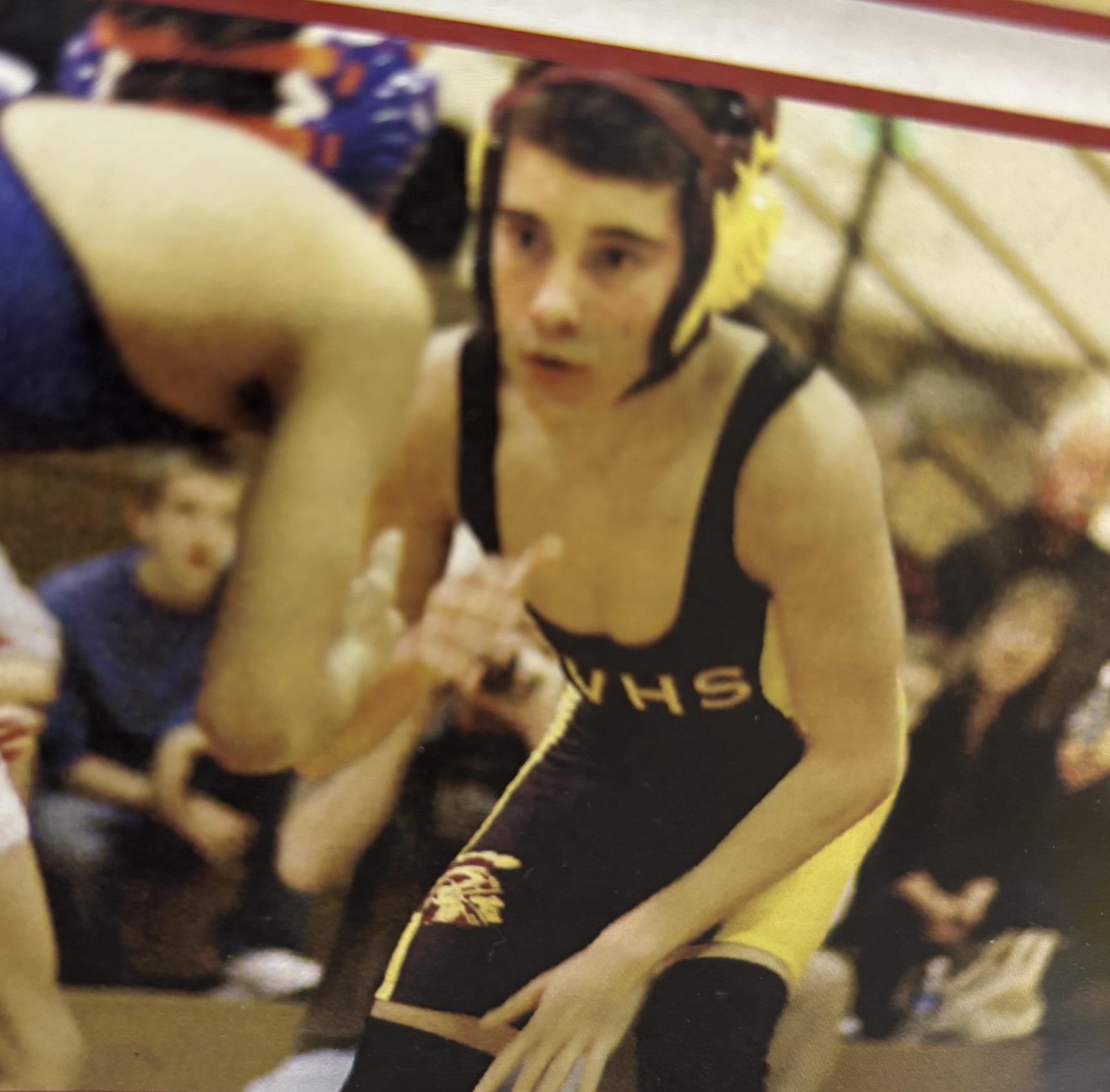
He joined the team and immediately became part of something bigger than himself. That season, Elliott placed second at state, a remarkable accomplishment for someone returning to the sport after several years away. He still jokes about the details that haunt athletes forever: he lost the championship by one point, and he had two technical violations—each worth a point—that ended up being the difference. Even with that narrow loss, he speaks of that year with pride, both personally and collectively, because the Trojans won the state championship as a team, and they did it convincingly. He remembers the team’s depth and dominance—the number of wrestlers who pushed into semifinals and finals, the sense that something special was happening, and the feeling of being part of a group that was firing on all cylinders.
And then, there was the emotional contrast that Elliott came to love every year: when wrestling season ended and golf season began. Wrestling brought intensity, physical grind, and the kind of mental toughness that comes from constant one-on-one competition. Golf, in Elliott’s eyes, was the “total opposite,” and that was part of the magic. It was still competitive, still demanding, but it came with a different pace and a different kind of satisfaction. That annual switch became its own tradition—one he remembers fondly as a rhythm of the school year.
Athletics weren’t his only focus. Elliott was also involved in leadership and academics, and he carried himself as someone who liked being useful. He participated in Honor Society and Student Council, serving as a class representative his freshman, sophomore, and junior years. Even now, he jokes that he never fully understood the official job description. In practice, though, he saw himself as the person who stepped in wherever help was needed—what he describes as a “handyman” role. He liked being in the mix, being dependable, and being someone others could count on to take on the tasks that kept events, plans, and day-to-day student leadership running smoothly.
By senior year, Elliott ran for class president and won, following a path his older brother, Nick, had taken before him. But his motivation wasn’t only about tradition. He had a long view, already thinking beyond graduation, because he understood that class leadership didn’t have to end when the cap and gown were packed away. He knew that being senior class president meant having a hand in organizing class reunions in the years ahead, and he liked the idea of being the person who brought people back together.
That sense of connection mattered to him then, and it still matters now. Elliott successfully helped organize his class reunion, navigating the complications and delays that came with the COVID era. What was originally intended as a 10-year reunion shifted into something closer to a 12-year reunion, but in the end, he and his classmates made it happen. He credits the effort and support of classmates who helped secure a venue through connections in Las Vegas, and he remembers the event as something that worked out well—proof that even when plans change, community can still come through.
When Elliott talks about his friend group from high school, he speaks with the warmth of someone who values loyalty but understands how adulthood reshapes time and geography. Some friends live in Las Vegas, many spent time in Reno, and others have dispersed across the country wherever careers have taken them. He describes it as a good thing—everyone building their own life, moving forward, doing what they’re meant to do. Even so, the connection hasn’t disappeared. One of the most meaningful touchpoints comes every Thanksgiving through wrestling alumni practice, a yearly tradition where former wrestlers return, step back onto the mat, and—just as importantly—reconnect.
For Elliott, that annual gathering is about more than wrestling. It’s about continuity. He appreciates that even if he only sees certain friends once a year, the bond remains intact. When they’re together, it feels like little time has passed, and the conversation picks up naturally, as if everyone is still standing in the same hallway, wearing the same school colors, laughing at the same stories.
After graduation, Elliott carried that same mindset into the next chapters of his life: work hard, stay involved, keep learning, and don’t be afraid to adjust course when something doesn’t fit.
He attended Southern Utah University and earned a bachelor’s degree in biology, a subject he still respects and enjoys to this day. After college, he returned to Pahrump and spent time substitute teaching, seriously considering a teaching job at Pahrump Valley High School. While exploring how to obtain a teaching certificate, he accepted an opportunity to enter a graduate program in Texas focused on higher education research.
Elliott’s explanation of why that program wasn’t right for him reveals how well he understands his own mind. He describes himself as naturally quantitative—comfortable with clear answers, measurable outcomes, and structured logic. The graduate research he encountered leaned heavily into qualitative approaches, interpreting complex human factors, living in the “middle ground,” and analyzing meaning through a different lens. He respected it. He appreciated his mentor. He saw the value in the work. But he also recognized that it wasn’t his path.
Instead of forcing himself to push through another multi-year program while uncertain, Elliott made a choice that would later become central to the advice he gives young people: he stepped away. He wasn’t quitting on learning or ambition—he was choosing alignment. He realized he had already spent years in college unsure of exactly what he wanted, and he didn’t want to repeat the pattern at a higher level simply because it looked like the next step. He wanted clarity, not momentum for momentum’s sake.
That decision opened space for something that had been there all along: golf.
When Elliott and Cierra—his then-girlfriend, now wife—planned to return to Cedar City so she could complete her degree, Elliott took initiative in a way that’s very consistent with how he led in high school. Before they even moved, he emailed the head golf professional at Cedar City’s only golf course. The response came back with enthusiasm: they would love to have him. For Elliott, it felt like the kind of timing you pay attention to—the kind that makes you think, “Okay, this might be the sign.”

He started working in golf, entered the PGA program, and never looked back. Over time, he became a PGA member and built a career that blends operations, hospitality, leadership, and the sport he always loved most.
In April 2021, Elliott joined Mountain Falls Golf Club. He initially served as assistant golf professional, but his role evolved quickly. By January 2022, he was promoted to Director of Golf, a position he has now held for four years. Even though his official title is Director of Golf, Elliott describes the work as far broader—more like a general manager role focused on keeping an entire facility functioning smoothly.
At the heart of his job is something he takes seriously: customer service. Elliott measures success by the experience people have from the moment they arrive to the moment they leave. He wants golfers to feel welcomed, supported, and genuinely glad they chose Mountain Falls for their day. And he’s quick to point out that delivering that kind of experience is a team effort. He credits the outside staff and front-of-house staff—the people golfers see most often—and he sees part of his own responsibility as building and supporting a team strong enough to make the entire operation feel seamless.
Behind the scenes, Elliott’s responsibilities stretch across nearly every part of course operations: managing the tee sheet, organizing tournaments, handling inventory, overseeing retail needs, working with vendors, managing reporting, onboarding and offboarding employees, and coordinating with ownership on priorities and planning. The one major area he doesn’t directly run is maintenance, which is overseen by the course superintendent. Even there, Elliott emphasizes collaboration—two sides of the same mission, working closely to balance budgets, communicate needs, and protect the quality of the course.
When it comes to the pace of play—something that can make or break a golfer’s day—Elliott is practical and calm. He notes that issues don’t happen often, but when they do, the course relies on marshals to keep things moving. Most golfers understand that golf takes time and that patience is part of the culture. Still, if one group falls far enough behind that it begins affecting everyone else, Elliott says the course reserves the right to require that group to skip a hole to catch up. That expectation is communicated early, though Elliott notes they haven’t had to enforce it yet—something he sees as a sign that most players are respectful and cooperative.
One of Elliott’s proudest priorities at Mountain Falls is the way the course supports junior golf, including high school tournaments. While some facilities treat junior events as inconvenient interruptions, Elliott takes the opposite approach. He believes junior golf is the future of the game, and he views every tournament as an opportunity to build lifelong golfers—“forever customers,” as he put it. Under his leadership, Mountain Falls has developed a reputation for being generous with its tee sheet when it comes to junior events, and Elliott says he rarely says no to opportunities that bring young golfers onto the course.
What stands out is that Elliott isn’t describing this as a marketing strategy—he’s describing it as personal. He benefited from junior golf himself, and he understands what it means to be a teenager given access to a high-quality facility. He also notes that regular players have been supportive, not resistant. In his experience, the golf community appreciates seeing young athletes develop, and junior events tend to bring out the best parts of the sport: respect, integrity, and etiquette.
That emphasis on character connects directly back to his own high school experience and to the culture he still values. Elliott speaks highly of the high school golfers, noting they are respectful and understand how privileged they are to have access to a facility like Mountain Falls. He also points to the role coaches and mentors play in reinforcing the values the sport demands. In his view, golf naturally teaches integrity and respectfulness, and that’s part of why he believes so strongly in giving juniors a place to grow.
Outside of work, Elliott’s life is full, active, and grounded in partnership. He and Cierra met at Southern Utah University, and their story includes one of the most unforgettable surprises: they got engaged and married on the same day. Elliott planned the entire thing, aiming to create the “elope” feeling Cierra loved while still including the family support that mattered to both of them. Cierra didn’t know what was coming, and both families showed up as part of the surprise. It’s the kind of story that fits Elliott—decisive, thoughtful, a little adventurous, and deeply centered on making moments meaningful.
Cierra has built an impressive career of her own. With an undergraduate background in mechanical engineering, she has continued advancing professionally, earning a master’s degree in data analytics and moving into a data analyst role with Mission Support and Test Services, a company involved with management work at a national security site. Elliott speaks of her with obvious pride, describing her as highly capable and always moving forward.
The couple bought a home in Pahrump and ended up almost exactly where Elliott’s story began—near the high school. He grew up about a block from Pahrump Valley High School, and now he and Cierra live about a block away on the other side. It’s a full-circle detail that feels fitting for someone who still values where he came from, even as he looks toward what’s next. Their home includes six chickens, a Chihuahua, and a mini Australian Shepherd. The dogs and chickens coexist carefully, with some separation, though Elliott jokes the chickens might actually intimidate the dogs more than the other way around.
When they’re not working, Elliott and Cierra spend their time doing what they love most: fly fishing, backpacking, and heading toward mountains whenever possible. Utah, Colorado, California—if there are peaks and rivers, they are drawn there. Elliott still plays plenty of golf, too, noting that many in the PGA world joke about having to “put golf away” because the job takes so much time. For Elliott, the passion has never faded. He still enjoys the game, still wants to play it, and still sees it as both career and personal joy.
Family remains important to Elliott, even with travel and distance shaping where loved ones spend their time. Both of Elliott’s parents still call Pahrump home, and he remains close with each of them as they continue to stay connected to the community. His brother spent several years living in Washington, D.C., before relocating to Denver. Elliott appreciates having him back on the western side of the country, and the family has even more excitement now with Nick newly engaged and beginning to plan for the future.
When Elliott talks about advice for younger people—especially students and athletes who feel uncertain about their future—his message is consistent and sincere: don’t do things simply because you’re told you should. He doesn’t speak from bitterness or from a sense that he wasted time. Instead, he speaks with empathy for how common uncertainty is, and he encourages young people not to fear it. He believes taking time to figure things out benefits people in the long run. The goal, in his view, is to prioritize happiness and alignment—choosing a path you feel strongly about, rather than staying in something that doesn’t fit out of obligation.
That belief ties directly into his future aspirations. Elliott wants to continue building Mountain Falls into a place he’s proud of—an operation that runs well, treats people well, and remains welcoming to juniors and longtime players alike. He also has an eye on the future beyond Pahrump. He describes Pahrump as a great place for their first home—quiet, affordable, and a solid home base. But he and Cierra can envision a move when the time feels right, possibly toward Denver near Nick, or toward Salt Lake City, once they’re ready for a new scene.
For now, they are focused on building wisely—financially and practically. Their property includes an extra empty lot behind their home, giving them options for the future, whether that becomes a second house, a workshop space, or something else that adds value and opportunity. It’s a very adult kind of planning, Elliott admits, but it fits the stage of life they’re in: investing, improving, preparing, and keeping doors open.
At the end of the day, Elliott continues to build a life rooted in passion, purpose, and connection. Whether he’s welcoming golfers onto the course, mentoring young athletes, or planning his next outdoor adventure with Cierra, he remains focused on doing work that feels meaningful while staying grounded in the community that helped shape him.

