

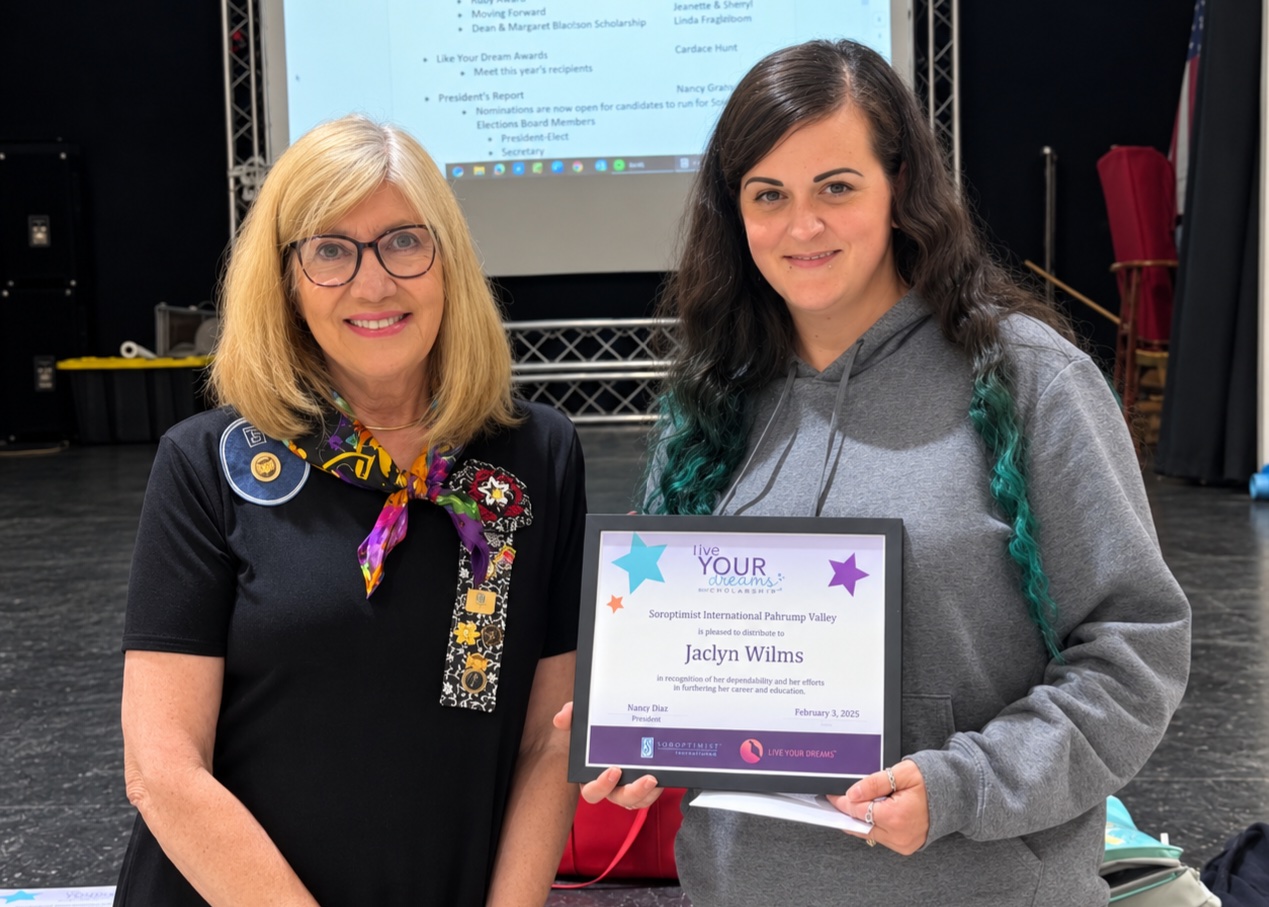

When Jaclyn Wilms received Soroptimist Pahrump Valley’s $1,000 second-place Live Your Dream Award in 2025, the recognition reached beyond the financial help. For a woman working full time, returning to school and supporting her family after years affected by addiction, it was an affirmation that her efforts mattered and that others believed in the future she was building.
“I think the Live Your Dream Award really just reinforced that other people believed in me and saw something in me that maybe I didn’t see in myself,” Wilms shared.
That belief came at a meaningful point in her life. Wilms was pursuing the education needed for a career helping people in recovery while taking on responsibilities at Living Free Health and contributing to her family’s household. She had worked to establish stability, overcome employment barriers and return to an ambition she first considered as a teenager: helping others, through drug and alcohol counseling.
Being selected for the award gave her encouragement to continue. It also connected her with women in her community who recognized the significance of balancing education, work and family responsibilities while pursuing a long-term goal.
Soroptimist’s Live Your Dream: Education and Training Awards for Women assist women who provide their families’ primary financial support and are pursuing undergraduate education, vocational training or skills certification. Funds can help with tuition, books, childcare, transportation, technology and other education-related costs.
For Wilms, the opportunity aligned with the life she was already working to build. Her goal is to become a licensed clinical social worker, and her work at Living Free Health allows her to use her experiences to support women and children while continuing her own education.
Applications remain available for the 2026-27 award cycle, with a November 15 deadline. Wilms hopes women considering applying will give themselves that opportunity, just as a coworker once encouraged her to do.
Understanding why that encouragement meant so much to Wilms begins with the years that brought her to it.
Long before recovery work became her career goal, Wilms had ambitions for a very different future. Growing up in Orange County, California, she was an honor student who imagined becoming a teacher or studying marine biology. She remembers being a young person with dreams and options ahead of her.
At 16, she was introduced to methamphetamine, beginning a struggle with addiction that would affect much of her young adulthood. Just before turning 18, she entered treatment for the first time and successfully completed six months. That experience introduced another possibility for her future: helping people through drug and alcohol counseling.
During that period in Palm Springs, she met the man who would become her husband. After returning to Orange County, Wilms learned she was pregnant with her son. Her husband already had a young daughter, and Wilms soon found herself moving from an uncertain teenager into the responsibilities of raising two children.
She began school and completed a year before her son was born. As the family established a home, she worked part time while her husband worked full time. Parenting, employment and a custody dispute involving his daughter filled their lives, and her education moved into the background.
For approximately the next decade, Wilms devoted much of her attention to being a mother. She volunteered at her children’s school and worked in areas that included administrative assistance and tax-related work. Those jobs provided experience and helped support the household, but she had not settled on a career she wanted to pursue long term.
Throughout those years, her father remained a steady source of encouragement. He reminded her that she was intelligent and capable, and that she could still choose what to do with her life.
“My dad was always the one that said, ‘You can do whatever you want to do with your life,’” Wilms recalled. “‘You’re a strong girl. You’re smart.’”
Around 2012, her husband relapsed, and the couple separated for a time. Their children were still young, and Wilms described feeling overwhelmed by the pressures around her. She also returned to substance use, beginning a period of approximately nine years that she now looks back on with an understanding of its lasting consequences.
She spoke openly about a criminal record that includes a felony and multiple misdemeanors, as well as time in jail. Those experiences later created obstacles when she tried to find work and establish stability. Her parents continued helping her and her children during that period, providing support she describes as a village around the family.
Wilms does not minimize the effect those years had on her children. Although she said they were never removed from her custody, she recognizes that the decisions she and her husband made affected them. She still carries guilt about that part of their childhood, even as she works to maintain strong relationships with both of them.
Today, being a stable, dependable mother is central to how she measures her progress. She is also learning to balance her desire to help her children with the need to set healthy boundaries, rather than allowing guilt to guide every decision. She speaks warmly about the young adults they have become and the importance they continue to have in her life.
“They make my life complete,” she said.
Her connection to Pahrump began through her parents. In 2021, they sold their Orange County home and moved to the area, intending to renovate a house left to them by her grandparents before eventually moving to Tennessee.
However, her father became seriously ill with liver failure, and Wilms traveled to Pahrump to be with her parents. She later returned to California to bring her daughter out and prepare for the move. Her son had already been staying with his grandparents.
While Wilms was still working to return, her father died on May 11, 2022. She was on her way back to Pahrump when he passed away. The loss remains painful, particularly because the parent who had so consistently believed in her did not get to see the stability she would later build.
“He never got to see me stand up on my two feet and do what he said I could do,” she said.
Wilms stayed in Pahrump to support her mother. Building a life here eventually meant confronting the changes she needed to make for herself, too.
Another arrest, which violated her felony probation, became a turning point. Her husband went to jail in California, and Wilms was in Pahrump facing a decision about what came next. She remembers reaching a clear conclusion: the cycle had to end.
“This is it. I’m done. I need to get my life together,” she recalled telling herself.
She entered an outpatient recovery program, Changes Recovery, enrolled in school and began looking for work. Progress came with setbacks. Finding employment in Pahrump was difficult, and her record complicated the search. After securing a casino job that she felt she was doing well, she lost that opportunity when her felony record prevented her from obtaining a gaming card.
For Wilms, the loss was especially discouraging because the job represented the ordinary stability she wanted: employment, routine and the ability to contribute.
“I just want a job,” she recalled. “I just want to have some kind of normalcy.”
Rather than abandoning her plans, she continued pursuing the recovery-related career that had interested her after her first treatment experience years earlier. She contacted Shelley Poerio at Living Free, initially learning that there were no openings. Later, a friend told her they were looking for someone. Wilms reached out again and was hired full time.
She credits Shelley with giving her a second chance at a moment when opportunities had been difficult to find. That opportunity also changed how she understood the experiences she brought to the workplace. While she regrets the years affected by addiction, she recognizes that her history can help her relate to people who believe their own mistakes have closed off their futures.
“I have a way to be relatable to so many people,” she said. “So many people that feel like they can’t get past their mistakes.”
At Living Free, that connection is part of her daily work. Wilms described responsibilities with the Parent Child Assistance Program, or PCAP, which she said Shelley incorporated into Living Free’s services for women and children after learning about the program developed in Washington.
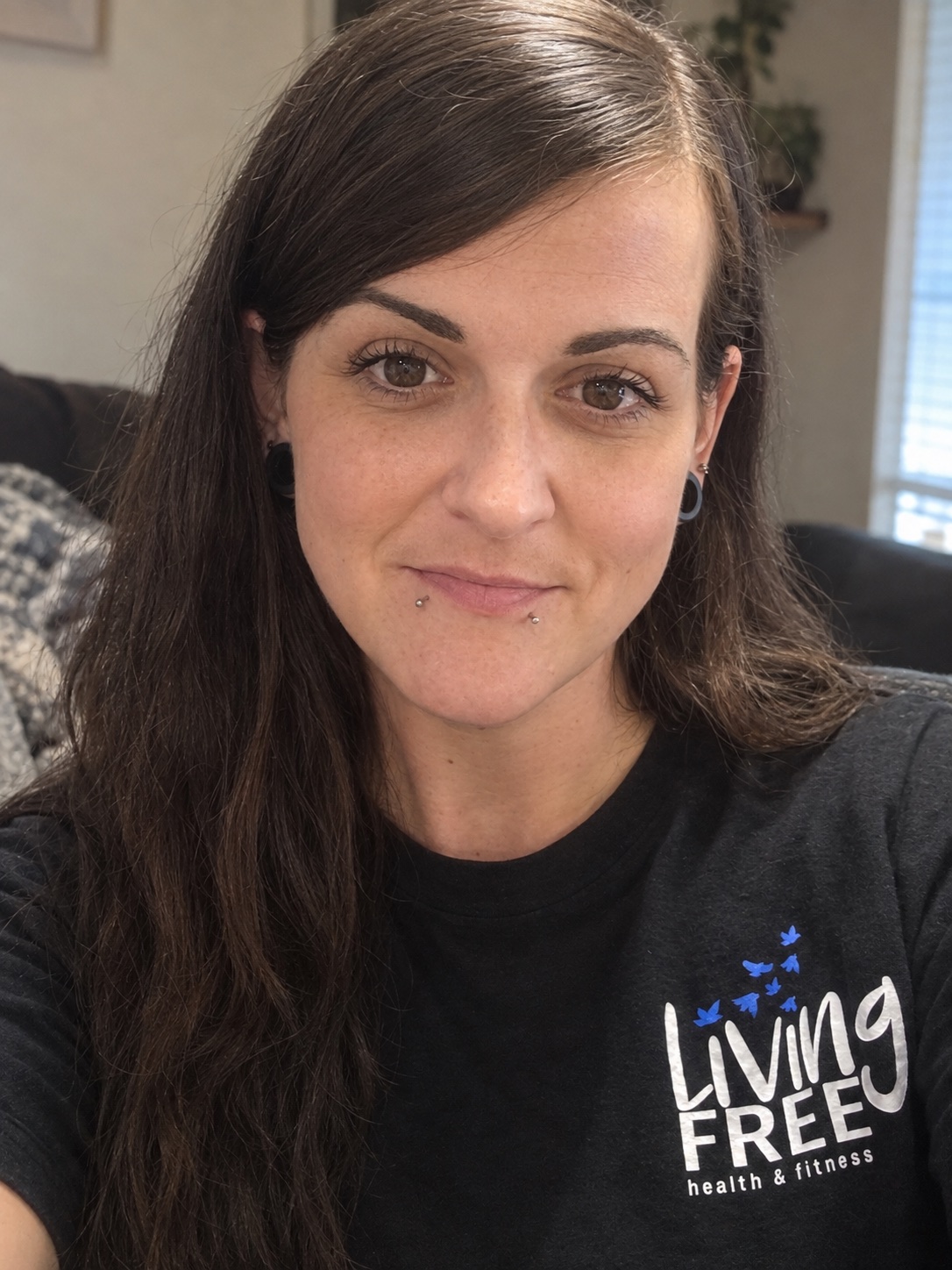
Her work includes supporting women through transitions involving family reunification, case management, client transportation, and care coordination. She also manages the women’s and children’s house and a separate women’s house.
The responsibilities extend beyond a predictable workday. With a work phone and clients who may need assistance outside regular hours, Wilms often feels on call. When children are involved, she knows some needs cannot wait until the next morning.
She is also teaching the women she supports to recognize the difference between an emergency and an everyday problem they can handle. One call, she recalled with humor, came from someone who had caught a lizard and needed guidance. Her response was simple: put it outside.
Those small moments sit alongside the more demanding responsibilities of helping people establish stability. Wilms wants clients to know she is available, while also helping them develop the confidence and skills to manage their own lives.
Asked whether she sees herself in some of the people who come through Living Free, Wilms said she does. Her approach begins with demonstrating through her own life that change is possible. When appropriate, she shares parts of her past so clients understand that the person helping them has faced difficult circumstances, too.
“You have to be the example,” she said. “You have to show them by just being genuine.”
She also believes effective support requires boundaries. She wants to give clients tools and encouragement without working harder than they will. Watching someone make progress and then return to harmful choices can be painful, especially when she has become invested in their success.
Still, she understands that another person’s decisions are their own. Her goal is to remain available if they are ready to seek help again. Her experience gives that outlook a personal foundation: she knows what it means to need another opportunity, even after an earlier attempt did not lead to lasting change.
Education is the next major part of the future Wilms is building. At the time of her interview, she was approximately a semester and a half away from completing her associate degree and described herself as enrolled in the “3 plus 1” social work program. She explained that her plans included pursuing her bachelor’s degree through Great Basin College and then a master’s degree through the University of Nevada, Reno.
Along the way, she planned to move from peer support into clinical work through a drug and alcohol counseling internship after completing her associate degree. She hoped to begin that stage at the end of May following the interview, gain the required experience and credentials, and eventually provide mental health services at Living Free.
Her long-term goal is to become a licensed clinical social worker. She recognizes that reaching that point will take years, but she is willing to keep working toward it. At 38 when interviewed, she reflected on returning to school later than she once expected and on the time still ahead before completing her plans.
“But that’s okay,” she said. “Because I have the drive to do it.”
Then she added, “I won’t stop.”
Balancing school with full-time employment requires a deliberate routine. Wilms sets aside specific evenings for homework and uses weekends for assignments as well. After a day spent responding to other people’s needs, school gives her time to focus on something she is doing for her own future.
She described the transition into homework as a moment to tell herself, “Now this is me, for me.”
Her evenings often consist of coursework, a little television and bedtime. The schedule leaves limited room for other activities, but it provides structure and keeps her moving toward the career she wants. It also helps explain why recognition from Soroptimist carried such weight: the award acknowledged the effort she was already putting into changing her future, one workday and one assignment at a time.
Soroptimist’s recognition became part of that progress through the encouragement of her coworker, Shauna Dragna. Having received the Moving Forward Award herself, Dragna suggested Wilms apply because of the obstacles she had worked to overcome. When the Live Your Dream Award opportunity arose, Dragna encouraged her to pursue that award as well, recognizing how closely Wilms’ efforts to continue her education and support her family aligned with its purpose.
At that point, Wilms was supporting her family while her husband was not working. She was also helping pay her mother’s bills, something that carried meaning beyond the financial responsibility itself. Her mother had supported her for years, and Wilms was grateful to be able to return that care.
“It feels amazing that I can do that for her and I can keep a household running,” she said.
When she was selected for the $1,000 second-place Live Your Dream Award in 2025, Wilms was recognized for efforts that included both advancing her education and supporting her family. She described the financial award as helpful, while emphasizing that the recognition itself encouraged her to continue.
The significance of that encouragement was rooted in what she had already experienced. She knew how discouraging it felt to seek employment and encounter barriers because of her record. She knew what it meant to postpone school while raising children and to return years later with a demanding work schedule. Having people recognize what she was accomplishing helped her look ahead with greater confidence.
She said the Live Your Dream Award and the Moving Forward recognition had continued to push her forward because they showed her that people noticed what she was doing. Her added reflection captured that feeling directly: others saw something in her that she had not always been able to see in herself.
She spoke appreciatively about the women of Soroptimist Pahrump Valley, especially Live Your Dream Awards chairperson Candace Hunt, and about the sense of connection she gained through their encouragement. The experience helped her feel more connected to the community where she was establishing a new chapter of her life.
“I’m just grateful that I got the opportunity to be part of it,” she said.
That gratitude has already turned into encouragement for others. Wilms has referred women to the award opportunity and answered their questions about applying. She has also provided a recommendation for an applicant whose efforts she believed reflected the award’s purpose.
For women who wonder whether they deserve recognition or have a chance of being selected, her advice begins with taking the first step.
“First of all, you’re never going to know unless you try,” she said.
The women she has encouraged were pursuing school, caring for their families and working past barriers of their own. Wilms sees those efforts as reasons to apply. She knows how easy it can be to underestimate progress while concentrating on everything that still needs to be accomplished.
“They’re taking care of their family and being successful,” she said of the women she encouraged. “And that’s exactly what that award embodies.”
Her willingness to recommend others reflects the effect the award had on her. A coworker helped her recognize that her circumstances and goals made the opportunity worth pursuing. Now, Wilms is offering that same encouragement to women who may need someone else to say that their efforts deserve consideration.
Her own support system has helped her recognize that progress. Her mother, whom she describes as a cheerleader, follows Living Free’s social media posts and enjoys seeing her daughter’s name and photograph connected to scholarships, awards and the work she is doing.
That support began long before the public recognition. Early in Wilms’ recovery in Pahrump, before she had a car, her mother drove her everywhere. Wilms credits that practical assistance with helping her reach the point where she could support herself and contribute to the household.
Reconnecting with extended family has also been meaningful. During a trip to California with her son, Wilms stayed with an aunt she had not seen in seven years. Her aunt, her father’s younger sister, greeted her with a large hug and told her how proud she was. The visit gave Wilms a chance to renew a relationship that had once been close and share the life she was now building.
Her circle in Pahrump has grown as well. While attending Changes, she met an older man and his wife who have become like grandparents to her. They live nearby, she checks on them regularly, and their encouragement has become another source of support.
Wilms also credits her best friend, Miranda Knowles, with being an important part of her support system in Pahrump. The two met in treatment and have helped each other through some of their most difficult times. Their friendship has become a source of comfort and encouragement, giving Wilms someone she can laugh with, cry with and confide in openly.
At work, she describes her coworkers as family. She also expressed appreciation for DJ Mills, Living Free’s vice president, who interviewed her and began working there the day before she did. Those relationships have helped make her workplace a place of friendship and belonging as well as employment.
“I think all the right people have been placed in my life for the right reasons,” she said. “And I’m forever grateful for that.”
Her marriage is another part of the stability she values today. Wilms and her husband have been together for just over 20 years. She recalls the early years as a time when they were best friends, before substance use brought conflict and periods of separation into their relationship.
When she committed to recovery, she told him clearly that continuing their relationship would require a shared commitment to change. She was afraid it might not work, but knew she could not keep repeating the same cycle.
At the time of the interview, both were approaching four years in recovery, with her husband approximately a month and a half behind her. Both were working full time. He had found steady employment doing pool work, and the couple was enjoying the routines and plans that came with a more settled life.
They had also purchased a Harley-Davidson motorcycle and begun taking rides together. Day trips have become a way to spend time as a couple and enjoy the area. He also rides dirt bikes, while Wilms often uses weekend time for schoolwork and rest.
Their life now includes work, family, homework and time together. Wilms speaks about those everyday details with appreciation because she knows how much effort it took to reach them.
“For now, we just have our little existence together, and I wouldn’t change it for the world,” she said.
When asked whom she wanted to thank, Wilms returned to the people who helped make that life possible: her family, her mother, her boss, her coworkers and the wider circle of people who offered support as she worked to rebuild. Their belief in her has been especially meaningful as she has learned to recognize her own capabilities again.
That is the lasting significance she sees in the Live Your Dream Award. The financial help mattered, and so did being recognized as a woman pursuing an education, supporting her family and working toward a future shaped by service to others.
Applications for the 2026-27 Live Your Dream Awards remain available through November 15 at www.liveyourdream.org. Applicants must demonstrate financial need, support themselves and their dependents, be enrolled in or accepted to an eligible program, and meet Soroptimist’s additional requirements. For more information, contact local awards chairperson Candace Hunt at 415-314-7040.
For women hesitating to put their own stories forward, Wilms offers the same encouragement she has already shared with others: give yourself the chance to be considered. Receiving the award helped her recognize that the work she was doing had value, and she wants others to have the opportunity to experience that encouragement, too.
She is continuing her education with a goal that began years ago and now informs the work she does each day. Through her own example, she hopes to help someone else believe that the next step is still possible.
“This is where I was,” she said of sharing her experiences with clients. “And you can do this too.”

